Wednesday, 27 January 2016

Question 5: How did you attract/address your audience?


Q5: How did you attract/address your audience?

To make our thriller appeal to our audience, we listened to what kind of conventions our audience wanted within a thriller opening and tried to include these in our thriller. Our audience wanted a thriller that contained a strong use of props, was fast paced, included a young child within it, created enigmas and had a good storyline element. We feel that we very easily filled these demands and that we have created something which is exactly what they wanted. We created a Vox Pop to thoroughly research what things our audience wanted


We made sure to create enigmas in our thriller opening. We did this by showing a board filled with newspaper clippings of young girls and reports of missing children to create enigmas that make the audience wonder where these children are now and what has happened to them and by who. Each clip hints as to what is happening in context of the film before the action actually takes place. It also creates enigmas as to what kind of person has created this and why. It portrays the character as being very obsessive and stalker like which causes the audience to wonder why this person is doing it too and what intentions do they have. We used low-key lighting to make it seem even more mysterious and we never gave away the identity of our antagonist so that it is clear that someone threatening is present within the film, however his identity is not yet to be revealed and it will not occur until later into the film. This will create suspicions on other characters that would later enter the film and keeps people guessing as to who it was at the start of the film. As well as this we also used audio clips from previous missing child cases to make it seem like this is something that has happened before and that these are the voices of the families that have had children who've fallen victim previously. We placed a reverb effect over the audio too, to make it sound like echo, so that it created more of the idea that these are memories that perhaps go through his head. So this creates enigmas as to whether or not he has actually done something like this before and how many children have previously fallen victim to him. Our audience said that they liked having enigmas within a thriller because its what engages the audience into the thriller and wants them to continue on watching the film for the enigmas to be answered. We got this information through doing our Vox Pop.


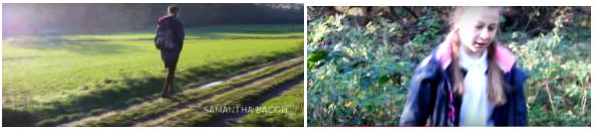
Another element we used within our product which was something that our audience wanted was a small child within the opening because they considered it quite creepy and unnerving to have someone so young in such a dangerous situation. We made her appear to look like a normal child as well, like your average school girl, to make it even more unnerving. Movies tend to avoid the reality of such events by making the child appear older or the violence not as threatening, so we thought by using someone so young and making her look so realistic it would be unnerving to the audience because it is confronting them with the harsh reality of these events. We told our actor to run through the forest and appear afraid which makes her look innocent and makes people feel sorry for her because she's confronted with something so dark which someone of her age should never have to go through. By using such a young child, people instantly feel sorry for her and feel the instinct to protect them which could cause them to instantly hate the antagonist.


We also used a wide variety of props because our audience said that a good use of lethal props was really effective. We used three main props in our thriller. These were leather gloves, a bottle of liquid and a cloth, and a piece of rope. All these props were supposed to insinuate danger and death for the targeted victim. The gloves represent how he is trying to avoid leaving any fingerprints so that he isn't caught for the crimes he has and is about to commit, the liquid and cloth represent that he is going to drug the child and so she is unconscious as he kidnaps her and the rope represents how she is possibly going to be strangled or tied up. We structured these clips to come in just after she's first introduced so that the audience immediately know that this child is in a lot of danger and that this character is intending to put her into a great deal of danger and possibly murder her. This linked to the feedback that our audience enjoy a movie that has a good plot line but is also fast paced and brings them to the edge of their seat.

Our product recieved a lot of positive feedback from those who watched it. We uploaded it onto our social networking sites and in total received 93 likes and many positive comments. Two people however mentioned there was one small fault and that was that the audio mentioned that  the 'child went missing on Saturday but she is wearing a school uniform.' However the audio is not about the child who is featured in the piece and is in fact clips of other children that have gone missing so the child missing on the weekend and the one featured in our product have no link. Within our Vox Pop, we received positive comments as well. People liked our thriller opening because it was faster paced than our previous cut and they loved the soundtrack that we put in because it really fitted into our piece and it made it incredibly realistic. The repetitiveness and the speeding up of the voices also created a lot of tension and excitements. They don't think that there are any improvements needed in our piece and overall they thought it was incredibly effective.
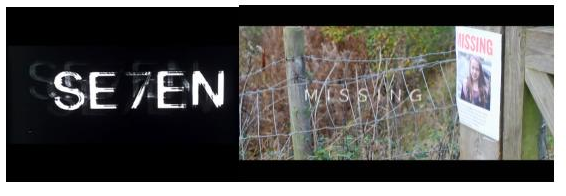
Our thriller links to other similar thrillers such as Se7en. Within the opening of Se7en we see a lot of close ups of sharp props and items that provoke the thought of danger. The identity of the criminal is never shown within the piece and all that is shown are his hands as he works on his books of victims and uses all of these sharp and dangerous tools. This links to our thriller because we also used an anonymous villain within our opening piece who is piecing together information about his victims and only his hands are shown throughout the scene handling the tools. The Se7en opening attracts the audience because it makes them want to watch on to find out what this person is creating with his books and why. It makes them want to understand what is happening and who the people are within the books are. So it also creates similar ideas in our opening because we keep our antagonist's identity hidden throughout the opening and it creates enigmas as to what he is doing and is going to do with the newspaper clippings and what his motif is. It is also located in a forest which is similar to The Hunger Games in which over 20 children fight to the death in an arena disguised as a forest. This isolates them completely from the outside and means that they can easily get lost and can be injured or killed by stumbling blindly through the forest alone. It also traps the children with one another and therefore puts them in complete danger. It is easy to get lost within the forest too and so it is an easy placed from them to completely get trapped within the forest and puts them in incredible danger. Our audience wanted to watch more from our thriller to find out what was going to happen to her and see if she'd be safe in the end.

Question 4: Who would be the audience for your media product?

Q4: Who would be the audience for your media product?

We decided that our target audience would be between the ages of 15 and 30 years old. It would be aimed at any gender because the conventions appeal to all of them and so it will allow for a wider audience to appeal to. We thought those of an average/normal background who enjoy going out to cinema and have interests in thriller movies. Similar things they may be interested in may include tv shows such as Orphan Black and The Walking Dead and movies such as Taken and Man on Fire. We thought that members of the demographic groups C2, D and E would be best to aim our thriller at. We feel that this mainly consists of younger people and part-time employees who have enough time to visit the cinema during the week to see our film as opposed to someone who has a fulltime job and may be made too busy by it or too tired out from it to watch a movie. We then decided to aim our thriller at people in the psychographic groups Explorers. We thought this would be a good group to aim at because they're attracted to adventure, experience and energy which is what they would find within our thriller. They like to try new things as well and so if we bent the conventions and made our thriller completely different and unique to other thrillers, they would be interested in viewing our thriller.

This is an example of how our audience may look followed by an audience profile:


  • Gender: All genders.  
  • Age: 15-30 = young adults 
  • Other media consumption: 
  • TV - shows such as: The Walking Dead, Orphan Black, Sense6, Hannibal. 
  • Movies - films such as: Taken, Man on Fire, Orphan, Hunger games. 
  • Video Games- The Last of Us, Fallout, GTA 
  • Magazines- Empire, SSFX, Entertainment 


Typically, they may follow what is popular at the time. They'll want to seek something that is incredibly entertaining and fun to watch and so they may seek out films that are incredibly popular at the time with everyone because they'd want to see what the fuss is about, especially if it is quite different. And so this means they would shop at popular shops such as HMV, Game and other similar popular movie and video games stores to find new media to keep them entertained.

To help research our audience, we created a vox pop to see what kind of thrillers and conventions of thrillers people of our target audience's age would enjoy. This was incredibly useful and it taught us a lot about what our target audience enjoys from their thrillers. The results came out as so:
Audiences enjoy thrillers that have a good use of props, such as guns and generally threatening or deadly weaponry within them, and a good chase scene within. A good opening will keep the audience wanting to continue watching the thriller and should include something dramatic in the beginning which will create a lot of enigmas for the thriller that need to be answered. It needs to be fast paced with lots of cuts to make it seem filled with action and keeps the audience on the edge of their seat. Storyline is also crucial to the thriller because it is what keeps the whole film going. Also recognisable actors make people more inclined to watch one thriller as opposed to one that does not include that said actor.

People like thrillers that are fast paced and use bright lighting so that it is not dark. However creepy elements are really engaging. It should play with the mind a lot and be constantly be asking questions because if the thriller is predictable then it ruins the idea of it being thrilling. There needs to be a lot of enigmas because it makes it exciting as to what will happen next. If there is some form of problem solving its engaging because it gets the audience to join in and think about how it could be solved. Interesting characters make for a good thriller because they make up a large part of the story and how enjoyable it is.

The BBFC (British Board of Film Censors) is a non-governmental independent organisation that reviews movies before they are released to establish a recommended age rating for them to be shown at.

Films rated at a 15 include:

  • strong violence 
  • frequent strong language 
  • sexual activity  
  • nudity 
  • sexual violence of references made to it 
  • drug taking 
  • discriminating language or behaviour 


Our thriller only contained the violence factor and drug usage. The violence in our piece was only mild however. So because of this, we looked at the 12 rating in the hope that it could be appropriate for even younger audiences.
Films rated at a 12 include:


  • Mature themes 
  • Mild language 
  • Brief nudity 
  • Suggested sex 
  • Mild violence 
  • Mild use of drugs 
  • Discrimination 


Our thriller had use of drugs, mild violence and mature themes. This could mean that our thriller could be rated at a 12 which means that our product can be viewed from a much wider audience.  Similar films that contain the use of these themes within them and have resulted in being rated a 12 are The Hunger Games franchise because of its deathly violence against children, drug usage in the form of berries that were used to kill an government official and mature themes because one of the characters that is later introduced is commented to have had his body sold to people in the Capitol in exchange for secrets.

Question 3: What kind of media institution might distribute your media product and why?

Q3: What kind of media institution might distribute your media product and why? 

A production company is a company that produces entertainment such as movies, television shows, plays or radio programs. Production Companies oversee projects whilst working closely with the director and may also provide with marketing and distributions. Within a production company there is a large amount of jobs that are needed in order to get everything done in time and produce a film successfully and in an orderly manner. Jobs that can be found within a production company include: 

  • Director: the person who is in charge of the movie. They decide what shot types should be used, what they want within the shot, choosing who to star in the movie and generally controlling the artistic and dramatic areas of the filmmaking.  
  • Writers: create the scripts and decided what should be said within the scenes 
  • Cast members: people who act within the film 
  • Sound designers: are in control of the sound within the film 
  • Typography: the person who controls how the text forms and is placed on the screen 

There are a vast amount of other jobs within a production company, but to summarise there is usually a job for every aspect of filmmaking.  

Our production is called Spotlight Productions. This name was chosen so that audiences can easily identify our company’s productions and the choice of ‘spotlight’ links into theatre and stage shows which use lightings such as spotlights and have a clear link to film and movie creations. We wanted something that was simplistic but also effective and memorable. Our ident consists of a black box with a spotlight within it. This is the trademark symbol of our company. Simplistic silhouette idents are more memorable than those that are more complicated and detailed and so we thought that it would be increasingly effective to use a memorable ident style. The simplistic serif fonts also help add to our production company ident because it gave across a sense of professionalism and success. 
Other companies that inspired our ident include those of The Weinstein Company, Touchstone Pictures and Spyglass Entertainment. 


The idents of these companies are simplistic with the first word usually bolded or are a larger scale than the name of the company. The silhouettes are all related to the title of the company. For example for Spyglass Entertainment, a silhouette of a man is shown holding a spyglass. These idents create some form of link between the movie industry and their title whilst also representing the sort of genre of films that these companies distribute. They also have a professional look to them and makes them appear to be distributors of films aimed at a more older audience rather than a young audience under the age of 12.  
A possible company that could alternatively distribute our movie would be Lionsgate. Lionsgate has produced several successful thrillers in the past, some examples being The Hunger Games series, Now You See Me and Sicario. We thought that Lionsgate was quite professional and skilled when it came to producing all sorts of genres of films but are especially skilled with thrillers. Lionsgate is located in Santa Monica, California. This is useful to our production because Santa Monica is home to a large amount of celebrities from Hollywood and filmmakers. So it would give us good access to very talented and popular celebrities. This is useful as we found that if someone recognisable was featured within a film, people would be more inclined to see a certain movie just because they are in it. Also found in California are numerous popular backlots and film locations, one example being Universal Studios Hollywood where films such as Pirates of the Caribbean, Psycho and Transformers. These are all incredibly popular movies that have a lot of success so by being distributed by Lionsgate we would have access to some of the best movie sets within California. Lionsgate is an independent film company and have distributed independent thrillers in the past. This makes them a good and affordable choice to distribute our thriller.  Lionsgate distributes movies that are shown all over the world and are sold in many countries in many languages so they have a large, global audience. 

Our thriller could be advertised through means of social media by taking advantage of hashtags or vines which are popular uses of media amongst those who are in our target audience. This is a cheap way of advertising our film to people and to get it trending so that it attracts a lot of people to the cinema and makes a lot of money at the box office to be able to pay back all of the expenses spent during creating the film. Another good way is to take advantage of what is popular with our target audience at the time and taking advantage of it. For example, when Disney released its movie Tomorrowland, they created a Minecraft map of the Tomorrowland world and created a game within it then proceeded to invite some of youtube's most popular gamers such as Yogscast Lewis and Simon and CaptainSparklez to play the game and upload the video to YouTube. This meant the film could be advertised in a fun and engaging way to over 16 million viewers. These are all cheap ways that our film can be advertised and encourage people to pay to see it. Also creating such things as Minecraft maps can be free if members of the production company have extensive knowledge in how to use the game.  

To make money to fund our film during the filming stage we could use charities to fund our movie production. One example of a charity of a fundraising charity is a website called Kickstarter. Kickstarter enables someone to set up a page about what they're planning to produce and the amount of funding they need in order to do it. They will also provide information about how the money will be spent specifically and when the final product should be created. A goal is usually set and people donate however much money they wish. When the goal is met, the kickstarter's organiser is expected to begin production of their product. To help encourage people to donate larger amounts of money, the people behind the kickstarter will usually offer donation packs. For example a small donation of £5 could result in a thankyou later and a movie voucher or keyring to be sent to that person. But a larger donation of £50 could meet the standard of a higher donation pack and bring a box load of goodies related to the film, like clothing, lanyards or other such accessories, sent to the donator or a chance to meet the cast or go to the premiere. 


Question 2: How does your media product represent particular social groups?

Q2: How does your media product represent particular social groups.


 In our media product we chose a young girl to be one of our main characters and an older male for the other. The young girl's age is supposed to represent her innocence and her overall character represents a typical victim character. Her age is supposed to cause an emotional impact on the audience as the young girl represents a typical child that maybe our audiences have themselves and plays on their parental instincts to make them think about what it'd be like if something happened to their children. Our actor represents a stereotypical young school girl. She has her hair plaited back since typically most schools require girls with long hair to tie it back to prevent the spread of lice. She has a standard primary school uniform on, school shoes and a large backpack which would carry all of her school books.


A similar character that we compared this character to is Pita from Man on Fire. Like our character, Pita is a normal, everyday young school girl. She has a similar costume to our character as well. In this particular screenshot, she has her hair tied back, a white blouse, a green cardigan and a skirt. This is similar to our character who wears the same clothes but just with a few colour differences. Her hair is also tied up like our character's. She also has blonde hair and blue eyes which makes her appear more innocent and fair. This is similar to our actor who also has light coloured hair and eyes. In the film, Pita's role is that of the victim. She is abducted in the movie and the goal of the film's story is for her to be rescued. This is similar to our character's role in the film, which is that she falls victim to a kidnapper and the goal of our story if for the mysteries of the missing children to be sold. We also have looked at real kidnap cases in the news such as the Madeline McCann disappearance.


Within our opening we used a lot of long shots of her running and close ups of her face. This was to emphasize the fear that she felt that she was being chased and show her frantic attempts at trying to escape him. The longshots also make her appear small compared to her surroundings which makes her therefore appear vulnerable. We didn't use any makeup on our actor because its something not usually worn by children because they're viewed as too young to. Although we did use makeup to make her look dirty after she'd fallen over. This was to show that she was so set on trying to get away that she is being careless as she runs and keeps falling over because she's trying so frantically to escape.

 We filmed her in the forest because it is a large area that she could get easily lost in because it is unlikely for her to have the knowledge needed to be able to maneuver through it. We also used lighter lighting when showing her compared to the antagonist because she doesn't pose as threat like the antagonist does. The lighting is natural that came from the sun through the trees. It added to the realism of the setting and made our character appear innocent and vulnerable because light is often associated with good things.  Audience might like this type of film because it is exciting and it challenges the typical conventions of a thriller movie which is usually dark and it is evident that someone is in danger but thrillers like this are unpredictable.

For our captor's appearance we made him appear much older than our victim. We wanted him to look like he was menacing and that he was quite a tall, intimidating looking person. We dressed him in dark coloured clothing such as black and dark green colours. We also wanted to dress him and make him appear like an everyday person who doesn't look like they should pose any danger so that we bend people's ideas of what a typical abductor or stalker may look like. We used a lot of shots from over his shoulder or looking at him from the ground to emphasis his height and we showed close up shots of him putting on gloves or gathering items such as ropes to make him seem even more menacing. We show him looking through newspaper clippings that he has collected and make him walk throughout the scenes to make it seem like this is something he does regularly and he does not feel remorse for it and he seems to treat it like a game. The walking helps to emphasize these because he seems so calm despite what he is about to do and it shows that he is dragging on the fear within the girl by pursuing her at a slow pace so that she doesn't get away but she is also still trying to escape him.


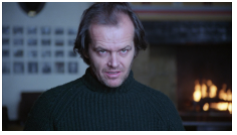
A character that can be compared to our villain is Jack Torrance from The Shining. Like our antagonist, he wears dark colours, he is male and he is quite old. Stereotypically, it is seen that men are the more stronger and more dominant of the genders which makes them seem threatening and frightening. This therefore creates fear towards the character. He is also wearing dark coloured clothes but they also seem like everyday clothing. This makes him look like he's just an average human being that couldn't possibly be as menacing or evil as he turns out to be. Unlike our character though, he is much more older and his role in the story is to be the father figure who becomes crazy. This twists the typical view of fathers who are expected to protect the family from danger.
Some props that we used with him were gloves, a cloth and a bottle of liquid, and rope. The gloves were supposed to represent him hiding his fingerprints so that he cannot be traced by authorities and it suggests that perhaps he's skilled at what he's doing and has done it before because he has learnt the precautions needed to been taken through in order to prevent him being found and done for the crime. The cloth and liquid are supposed to represent chloroform and something that would be dangerous for the victim. Chloroform can also be a deadly liquid if too much of it is inhaled and so it shows that the villain has access to a wide amount of deadly weaponry and poisons etc... and finally the rope is supposed to represent how it is going to put the victim into danger. It insinuates that she is going to be strangled to death or tied up. All the props appear as very dangerous and deadly and therefore strike fear into the audience. We also filmed him within the forest to chase after the young victim. But aside from the forest we also filmed within a garage. This garage was supposed to represent his place where he stalks his victims, keeping collected information about them and where all the weaponry is located. It was supposed to represent how he leads a daily life but there is a secret dark side to him that is hidden away within a room that isn't usually accessed by anyone else but him and the victims he brings there if any. The lighting in these scenes is quite low-key too, this is to hide his idenity and make him appear mysterious and menacing.


In comparison, our victim and our antagonist are complete opposites. The antagonist is portrayed as being strong and dominant. He seems threatening and dangerous. Our victim is very young which makes her seem very vulnerable. It creates tension because people fear for the child who is supposed to be innocent and not exposed to such dark themes like this and so fear is created between the massive age gap.

Question 1: In what ways does your media product use, develop or challenge forms and conventions of real media products?


Q1: In what ways does your media product use, develop or challenge forms and conventions of real media products? 

Thriller:

A thriller is a genre of media, typically in the form of film or literature, which stimulates specific moods within
the individual. These moods often include anxiety, worry or fear and aims to engage the viewer by keeping them on the edge of their seat. Thrillers usually include a storyline that follows the life of a hero that aims to take down a villain that seeks revenge. This results in the climax of the film being the point where the two meet and fight one another. They’re typically set within realistic places to make it seem like it is something that could happen in ordinary day to day life. 
Within the thriller genre there are numerous sub genres. There are many sub genres that a thriller can fit into and those sub genres depend on the content featured within the thriller. Some examples of subgenres are: 
  • Religious thrillers: where the thriller is heavily religion based 
  • Sci-fi thrillers: based in futuristic societies usually on other planets within space 
  • Action thrillers: contain a lot of violence and often include a quest that needs to be fulfilled 
  • Crime thrillers: follows the story of a detective or investigator trying to overcome issues whilst solving a crime 
  • Eco thrillers: usually include characters trying to overcome a natural disaster that has occurred 
  • Mystery thrillers: antagonist and protagonist competing to solve mystery 
  • Romance thrillers: follow a lot of dialogue and are based in realistic settings 
  • Supernatural thrillers: include supernatural elements within the thriller and are often disturbing or frightening to the viewer.  
For our thriller opening, we chose the mystery sub-genre because it included a lot of enigmas towards our child kidnapper and it creates a mystery that could be solved as the aim of our movie. As a mystery thriller, our audience will expect the mystery behind who the kidnapper is and why he is taking children and whether or not the child will be saved or if she’ll become another victim. To keep our thriller under the mystery subgenre we used specific conventions. We created an unsolved incident which will be open to be solved by a detective (the protagonist) later within the film. Our kidnapper has become the villain of our thriller and this is who the protagonist will later confront at the climax of the film when he has followed all the clues and has enough to solve the crime. We used a few fades from and into black within our piece. We used it at the beginning to make it seem like the opening was a memory to imply that this was an event that had happened previously and numerous times before. We used quick fades to black when the child is looking around at the forest to create the idea that she is growing tired and that she is hallucinating slightly due to this. These are all typical elements of a mystery thriller which we developed to suit the narrative of our movie.  

Thrillers contain specific conventions that classify thrillers as thrillers. These conventions can be categorized within the following things: 
  
  •  Narrative: A hero trying to stop an evil villain who seeks revenge on the world.  Thrillers that include this sort of storyline include The Hunger Games, the villain being President Snow who forces children to fight to the death and the hero being Katniss who seeks to stop the games. 

  • Lighting: Low key lighting to make a sharp contrast between light and dark. These are used in a lot of thrillers and are an important aspect of Mise-en-scene. Usually it is used to hide the identity of a certain character or hide things in the darkness. This causes a strong contrast between light and dark and can cause a lot of tension. A good example of low key lighting is the scene in Jurassic World when Owen and the raptors are searching the jungle at night to look for the Indonimous Rex that is hiding somewhere amongst the darkness and will most likely kill everyone. 


  • Sound Effects: Slow, low pitch music often plays within the background to create tension. Sound effects such heavy breathing and screams are also used.  The most famous piece of soundtrack and sound effects would be that of Alfred Hitchcock’s Psycho. Within the scene a woman is taking a shower when she is suddenly stabbed to death by another woman. During this scene the music is very slow and low pitch until the victim starts being repetitively stabbed and the music erupts into loud, high pitched violin screeches which adds to the tension and fear that is being created within the sequence. The music then fades back to the slow low pitched sound it was before when the victim is dead. The music almost resembles how the victim was calm until she was stabbed and the high pitched music resembles her fear. When it returns calmly it could represent her life slowly fading away. In this scene they used sound effects to make it sound like the victim had actually been stabbed. The music in this piece is synchronous because it follows through the build up, climax and downfall of the event and diegetic sound comes from the woman who is screaming and it can be seen that she is. The music score was created specifically for this scene and it also works as incidental music. There is also a use of ambient sound for the water falling from the shower to remind the audience that she had been in a place of safety but it has been threatened. Sound bridges may also be common in thrillers when a character screams. For example in movies like Tron Legacy, though it is not a thriller, the sound of a woman screaming out her grandson's name in panic is heard through a soundbridge as we see him run away as a child and the scene cuts to him as an adult.  


  • Camera: Shots avoid revealing the identity of the villain until later in the film. There are a lot of jump cuts and close up shots. Shots like the can also force the audience to look at a specific object or event that is unfolding that is either crucial to the story or that is significant to create fear within the viewer. Psycho is also a good example of this as it uses close ups of the knife to show the audience that the victim is in danger before the victim knows it themselves and it focuses a lot on the water so that the water creates some sort of significance to later when the body of the victim is dumped in a river.  

  • Mise en scene: The locations are usually realistic. Locations such as forests are effective because they create the idea of isolation. Constant changing settings create the idea that the character is running away from something or someone. Props are usually quite intimidating and create fear and danger when they’re shown. Props are usually guns or knives. In Skyfall, a lot of guns are used throughout the movie. 
A thriller opening should create enigmas and mysteries that will keep the audience interested in what’s going on within the narrative and want to keep them watching. A boring, slow paced opening that doesn’t create enigmas may cause the audience to switch off or not feel the desired emotions, such as fear, within the opening. An effective thriller opening should be fast paced and suspenseful. It should create excitement within the viewer and keep them on the edge of their seats. It should create lots of enigmas so that people keep guessing what could happen and it should build the foundations for a good narrative. An example of an effective thriller is that of the 2009 Sherlock Holmes.  

This opening sequence creates many enigmas and uses a lot of typical thriller conventions. A lot of low key lighting is used which hides the identity of the majority of the characters. The low key lighting doesn’t obscure the identity of the major characters however or characters that the camera wants you to focus on for the plotline which is effective because we establish who the main characters are and the props that they’re holding which in this case are guns. It creates questions such as ‘what’s about to happen?’ and ‘why do they have these weapons?’ It establishes a range of enigmas and creates anticipation within the audience. The lighting also builds up a climax to the main character of the movie, Sherlock. By hiding his identity right until the end of the sequence, it creates excitement and wonder as to whom this character is and establishes that this is the main character overall. 

The setting is realistic though it challenges the conventions of a typical, realistic setting as it takes a location – London in this case – and reassembles it to what it was during the Victorian Era of history. However it is still very realistic in the sense of its time period. For example a foggy atmosphere links to when the Industrial Revolution took place and factories let out intense amount of pollution into London’s atmosphere. It is also a city which is effective too because it means that there is potential for a lot of danger and crime because it is so heavily populated. The many back alleys and passage ways make for good hiding spots for danger and so overall the location and setting can create a lot of fear and tension.  The characters themselves’ are also wearing clothing of that period which help to add to the realism of the scene. We can establish the social classes of each of the characters too, because clothing during the Victorian period was a symbol of your social class. We can also recognise some of the jobs that these characters do, for example it is clear that the people within the carriage are part of the police.  

The narrative within the opening resembles that of a crime thriller. It is evident from the costumes and props that it is the police that are currently running to the scene of a crime. It establishes the foundations to a crime thriller because it shows that a crime has been committed or is being committed and so that means there will be some form of villain within the story that our hero will have to face.  

The sound effects used are also typical of a thriller. Before the action begins the music is very slow and low pitched, creating what feels like a sense of ‘calm before the storm’. Diegetic noises such as the sound of horses’ hooves and carriages passing by help to establish a calm atmosphere.  When the carriage passes by, the music starts to rise in pitch and begins to slowly become more fast paced which helps to develop excitement and anticipation for what is coming at the climax of this scene.  
The camera follows the moving carriage throughout the whole sequence and by doing this it creates the feeling that the carriage is going incredibly fast which implies the sense of emergency. It therefore creates enigmas towards the crime and how severe it must be or if they’re trying to catch the person who’s in the middle of committing it. It also creates the same effect when it follows Sherlock throughout the scene. It cuts quickly between the police carriage and Sherlock which almost appears like a dual narrative, showing that the police have assembled together to solve the crime from Scotland Yard and Sherlock has come from elsewhere with the same intentions but by himself. It denotes a bit of Sherlock’s characteristics and how he never directly worked for Scotland Yard and for Lestrade though Watson did involve himself a bit more and that is why he is with the police. There are a lot of close ups to props such as guns and the characters readying their guns which implies that what they’re about to find is a threat and that they are going to need protection whilst they confront their villain.  
All of these conventions combine together to make an incredibly effective thriller opening that keeps the viewer on the edge of their seats and creates many enigmas as to what is going on and what they’re about to face. It establishes the foundations of a crime thriller and starts to build a storyline within the first minute of the movie. It is very fast paced and uses typical music and sound effects of a thriller to grow anticipation. 

There are numerous thrillers that inspired our thriller. We looked at a variety of thrillers and each of us found similar thrillers that we combined influences from to create the idea for our thriller.

One of the inspirations was BBC’s Sherlock Holmes the Hounds of Baskerville episode. This followed the story of a gigantic hound that haunts a nearby forest and kills the father of a small child, named Henry, who tries to escape the forest and is too afraid to return to it because he is so traumatized by the event. This helped to influence the idea of filming within a forest because they’re incredibly isolated. Anything can be hiding or can be hidden within a forest and victims can be far away from any sign of civilization which could save them. Within this episode, the characters become isolated by themselves and cornered by the threat of what they thinks is the hound and the actual killer of Henry’s father. 
In our thriller we used a forest location to isolate our victim with our antagonist. The forest acts like a maze that our victim can get lost within and eventually become caught in. In a forest it’d be easy for the victim to become lost or to run into other dangers. 
Another thriller that inspired us was Taken. Taken is a thriller movie about a father whose daughter is taken and he has to rescue her. The daughter is essentially the victim of the movie and her capturers are the antagonists. This influenced our thriller because we thought that it would be particularly effective on an audience that have children because it seems to be more upsetting if a child goes missing rather than an adult. In our thriller we used a very young child to be the victim of our opening. We thought maybe this would be more effective than using an older victim because they’re more vulnerable and they’re innocent. We also incorporated other, real cases of children’s missing cases to make it sound like other children have gone missing and their parents have desperately tried to find out where they are and are telling them that they want them to come home soon.  


Conventions in our thriller 
Our thriller opening uses a lot of these conventions. Within our thriller opening, we used a range of props that insinuate danger. We used props such as rope and a water bottle which is supposed to represent chloroform. These are both threatening props because the rope can be used to strangle a victim and the chloroform can knock them out. By showing these props at the beginning of the opening it insinuates that the villain has bad intentions and that the child is in a lot of danger.  So this will create fear and nervousness within the audience at the beginning of the thriller and creates enigmas which make them question what is going to happen to the child when she’s captured. 
Other thrillers that use props to show that children will be in danger is The Hunger Games. The characters begin at the start of the games by running towards a weapons haul so that they can pick and choose weaponry they find best to later murder the children they're up against in the arena. 
Our thriller opening’s storyline introduces a villain into the equation after committing a crime which in this case is kidnapping. This is typical of a thriller because it means that a ‘hero’ can be introduced later into the film that will ultimately save the day. This also is what makes our thriller a mystery thriller because a mystery thriller is categorised as having a villain that has committed a crime and a hero that has to solve the mystery of these crimes and stop the villain from committing anymore. By introducing the villain and showing him committing a crime, it creates lots of enigmas for the audience such as who this person is stalking the girl and why he is.   
An example of a thriller that we can compare this to is Sherlock Holmes A Game of Shadows. Sherlock Holmes is introduced as the hero of the movie and he has to defeat the villain of the movie, Moriarty. Sherlock Holmes searches for clues throughout the movie and tries to solve mysteries and clues to find out who and where Moriarty is after he attacks John Watson and his Wife and has committed crimes relating to bombing. Ultimately Moriarty is defeated by Sherlock by jumping off Reichenbach Falls with him.
The setting and location is typical of a thriller movie as well. Typically within thrillers the setting is usually isolated or desolate. It is cut off the real world so that the victim of the film is on their own and has to fend for themselves against the antagonist. We chose a forest because it is incredibly isolated. Forests are huge and it is easy to become lost within them or trapped or even injured by the forest alone. By doing this we felt it would create the most response out of the audience because they will see our victim get easily lost within the forest and it will cause them to worry for her as she tries to seek out help or a way out of the maze of trees. It also creates the sense of claustrophobia because the child is surrounded by the large volume of trees around her and the more she runs deeper into the forest it creates the sense that more trees are surrounding her and she is becoming further and further lost in the woods and further away from safety.  
An example of this in a real thriller is Psycho. The victim is murdered in Bates Motel which is somewhere isolated but also somewhere to be thought of as being safe. It creates the idea of claustrophobia too because it brings about the idea of entrapment because the guest of the hotel is not the only person that can get into a room and has keys to be able to get in.  
Our props are typical of a thriller film because most of them are lethal and deadly. Two of the props that we used fell under those categories. The first prop was a bottle of liquid and a cloth. Though in actual fact the liquid was just water, because it would be against health and safety regulations to use the actual liquid it was supposed to represent, it was meant to look as if the antagonist had a bottle of chloroform that he was going to use to cause our victim to become unconscious when he captures her. The second prop we used was a piece of rope that he would fiddle with in his hands. This would create the connotation that he was either going to strangle his victim to death with the rope or that he was going to tie her up. Both of these props imply a great deal of danger to the victim. Rope is a restraining piece of material that can be used to prevent something from running away and keeping them in a certain place or for deadlier matters such as strangling or hanging a human to death. Chloroform is a liquid that can make one become unconscious which is very dangers because it means that anything can be done to them without them feeling any pain or being aware that it is happening because they are completely out. Some people, particularly historians, may also be aware that small dosage of the liquid can result in just a person becoming unconscious but a slightly larger dosage can actually kill a person.  
The camerawork also follows typical conventions of a thriller. We used a lot of close ups and over the shoulder shots to prevent revealing the identity of our villain. This allowed enigmas to be created as to the identity of our villain and why he is doing such things. It also means that when characters are later introduced into the movie, people will become suspicious of each of the characters introduced and start to become engaged with the film's story as they try and figure out themselves who is actually behind all of the missing children cases. We also used close ups on our victim. We did this so the fear and panic that she was feeling could be shown through her facial expressions and be made obvious to the audience. By doing this they start to sympathise with the victim and it could possibly trigger the audience themselves to also feel panicked or scared. By showing the emotions of the characters,  it establishes the atmosphere and intended emotions within the audience. Extreme close ups were also used within our sequence because it brings the audience uncomfortably close to specific details within a shot and it makes the shot more dramatic.  

We used a lot of longshots within our sequence too, especially when we panned the camera, so that we can see the victim running away and show the antagonist lurking somewhere within the background. These longshots allowed us to show the victim running through the forest and showing the audience that the forest is hard to navigate and there is no clear way in or our what so ever within the scenes. Composition wise, she took up a small amount of the rule of thirds whilst the forest trees dominated the composition. This emphasized the victim's vulnerability and innocence because she appeared so small and she was surrounded by something that was overwhelming her. When we panned the camera we used a tripod whilst doing so so that the camera's movements were smooth through the clip. By panning too it allows to smoothly show the character moving through the forest without having to constantly change the clip to a new segment of the forest to show her clearly moving throughout it.  
Typically of a thriller movie, the clips and footage is edited in a fast pace. And so when we edited our piece we made sure that the clips within our product were kept short so that we could quickly cut between them and create a fast pace. By creating a fast pace with our product, it creates suspense and action. It also reflects how quickly the victim is trying to escape from the antagonist as she tries her best to run away from him. Being fast paced, it makes the opening feel exciting and engaging because so much is going on and it is only the beginning of the film. A lot can happen within these short moments so it also enables us to set up enigmas and the foundations of the story for our thriller. We kept our footage as raw as possible and kept the lighting within the piece as natural as possible. We used bare minimum visual effects and the ones we did use were just basic pan/crop edits to create the hazed appearance on the trees and levels to help balance out the brightness within the product.  
Other thrillers that use fast paced editing with short clips is Godzilla when Godzilla faces the two Mutos. The fight is violent and a lot is happening so there are a lot of fast past quick shots that make the fight look more exciting and shows that there is a lot going on. These clips especially work well at this pace when it is obvious that Godzilla has begun to bleed and the two Mutos have started to overwhelm Godzilla.  
Our titles and font selections also are typical of thrillers. Thriller fonts usually reflect the themes or style of the movie's storyline. For example, the Se7en opening adopted a handwritten font which resembles how the antagonist in the film creates books of his victims. And the thriller movie Taken uses a thick, grungy red font because it links into governmental influence in the film. We chose to use a handwritten font as our title because we were inspired by the way the antagonist from Se7en records data of his victims which is similar to what our stalker in our product does with his. So we used it on the names of the crew members and the title of the thriller to make it appear like the antagonist had written it himself and help to link it into the thriller's story. It also further suggests an idea that there are multiple victims. For production company jobs, we used a more formal font to differentiate them from the names within the opening sequence. 
In conclusion, our thriller uses a lot of typical conventions for a thriller such as low key lighting and face paced editing. But it also develops and challenges conventions because we used a much younger victim in our product when usually the victim is of a much older age. By doing this it had a more emotional impact on our audience.